|

TOLKIEN AND THE LORD OF THE RINGS
David W. Cloud & Posted by
Permission
(Pictures added David L. Brown)
Christianity Today ran a positive review of the books and the movie entitled "Lord of the Megaplex." Focus on the Family praised Tolkiens fantasies and promotes the book "Finding God in the Lord of the Rings" by Kurt Bruner and Jim Ware (Tyndale House). The glowing advertisement at the Focus on the Family web site calls fantasy a "vehicle for truth" and says: "In Finding God in the Lord of the Rings, Kurt Bruner and Jim Ware examine the story behind the stories the inspirational themes of hope, redemption and faith that Tolkien wove into his classic tales." World magazines review is titled "Powerful Rings" and claims that the "movie version of Tolkiens book speaks to todays culture." There is no warning in these reviews about Tolkiens occultic imagery.
Is the Lord of the Rings harmless fantasy or perhaps even a wholesome Christian allegory? We think not. I read The Hobbit and the three volumes of The Lord of the Rings in 1971 when I was in Vietnam with the U.S. Army. I was not saved at the time, and, in fact, I was very antagonistic to the Christian faith; and had the books contained even a hint of Bible truth, I can assure you that I would not have read them at that particular point in my life. Though I have forgotten many of the details of the books, I can recall very vividly that they are filled with occultic imagery. The books were published in inexpensive paperback editions in the late 1960s, and they became very popular with that generation of drug headed hippies.
As a professor of literature at Oxford University, Tolkien specialized in Old and Middle English and loved ancient pagan mythology. His first fantasy novel, The Hobbit, appeared in 1937, and The Lord of the Rings, in 1954-55. Several others were published later, some posthumously. One of Tolkiens drinking buddies was the famous C.S. Lewis. They and some other Oxford associates formed a group called the "Inklings" and met regularly at an Oxford pub to drink beer and regale about literary and other matters. Tolkien, in fact, is credited with influencing Lewis to become a Christian of sorts. Like Tolkien, though, Lewis did not accept the Bible as the infallible Word of God and he picked and chose what he would believe about the New Testament apostolic faith, rejecting such things as the substitutionary blood atonement of Christ. And like Tolkien, C.S. Lewis loved at least some things about Catholicism. He believed in purgatory, confessed his sins to a priest, and had the last rites performed by a Catholic priest (C.S. Lewis: A Biography, pp. 198, 301) J.R. Tolkien died in 1973 at age 81, two years after his wife, and they are buried in the Catholic section of the Wolvercote cemetery in the suburbs of Oxford.
The setting for Tolkiens The Lord of the Rings is in "Middle Earth" and the hero is a little creature (a hobbit) named Frodo Baggins who accidentally becomes possessor of a magical ring that is the lost and greatly desired treasure of the "Dark Lord Sauron." The story line revolves around Frodos action-filled journey to take the ring to the Cracks of Doom where it can be destroyed. The individual titles of the trilogy are "The Fellowship of the Ring," "The Two Towers," and "The Return of the Ring."
In his last interview in 1971, Tolkien plainly stated that he did not intend The Lord of the Rings as a Christian allegory and that Christ is not depicted in his fantasy novels. When asked about the efforts of the trilogys hero, Frodo, to struggle on and destroy the ring, Tolkien said, "But that seems I suppose more like an allegory of the human race. Ive always been impressed that were here surviving because of the indomitable courage of quite small people against impossible odds: jungles, volcanoes, wild beasts... they struggle on, almost blindly in a way" (Interview by Dennis Gerrolt; it was first broadcast in January 1971 on BBC Radio 4 program "Now Read On"). That doesnt sound like the gospel to me. When Gerrolt asked Tolkien, "Is the book to be considered as an allegory?" the author replied, "No. I dislike allegory whenever I smell it." Thus, the author of The Lord of the Rings denied the very thing that some Christians today are claiming, that these fantasies are an allegory of Christs victory over the devil.
Tolkiens books created the vast and spiritually dangerous fantasy role-playing games that are so influential today. Dungeons and Dragons, which appeared in the early 1970s, was based on Tolkiens fantasy novels. One fantasy-game web site makes this interesting observation: "The whole fantasy adventure genre of books came into play when J.R. Tolkien wrote his The Lord of the Rings books. From his vivid imagination and creative thinking he created the fantasy adventure genre. Tolkien probably got his ideas from ancient religions. Peoples of different civilizations were writing epics way before Tolkien was even born. They wrote epics about people with superior strength, about gods that punished people and, travels to the underworld. Tolkien is accredited to being the man who started it all but if traced back even further you'll see that he wasnt the one that created it, just the one that pushed it forth." This secular writer better understands what Tolkiens books are about than the aforementioned Christian publications. Tolkien certainly did get his ideas from pagan religions, and the message promoted in his fantasy books is strictly pagan.
Tolkien has influenced many rock and rollers. The song "Misty Mountain Hop" by the demonic hard rock group, Led Zeppelin, was inspired by Tolkiens writings. Marc Bolan, of the rock group Tyannasaurus Rex, created a musical and visual style influenced by Tolkien. The heavy metal rock group Iluvatar named themselves after a fictional god from Tolkiens work The Silmarillion. Others could be mentioned. The world knows its own; and when the demonic world of fantasy role-playing and the morally filthy world of rock and roll love something, you can be sure it is not godly and it is not the truth. February 5, 2002 (David Cloud, Fundamental Baptist Information Service, P.O. Box 610368, Port Huron, MI 48061, 866-295-4143, fbns@wayoflife.org) [Distributed by Way of Life Literatures Fundamental
Baptist Information Service. These articles cannot be stored on BBS or
Internet sites or sold or placed by themselves or with other material in
any electronic format for sale, but may be distributed for free by e-mail
or by print. They must be left intact and nothing removed or changed,
including these informational headers. The Fundamental Baptist Information
Service is a listing for Fundamental Baptists and other fundamentalist,
Bible-believing Christians. Our goal in this particular aspect of our
ministry is not devotional but is TO PROVIDE INFORMATION TO ASSIST
PREACHERS IN THE PROTECTION OF THE CHURCHES IN THIS APOSTATE HOUR. This
material is sent only to those who personally subscribe to the list. If
somehow you have subscribed unintentionally, following are the
instructions for removal. To Subscribe to the Fundamental Baptist
Information Service, send an email to lists@wayoflife.org and put
"subscribe FBIS" in the subject field. To Unsubscribe, send an email to
lists@wayoflife.org and put "unsubscribe FBIS" in the subject field. To
change addresses, simply unsubscribe the old one, then re-subscribe the
new one. We take up a quarterly offering to fund this ministry, and those
who use the materials are expected to participate (Galatians 6:6). Some of
these articles are from O Timothy magazine, which is in its 19th year of
publication. Way of Life publishes many helpful books. The catalog is
located at the web site: http://www.wayoflife.org. Way of Life Literature,
P.O. Box 610368, Port Huron, MI 48061. 866-295-4143, fbns@wayoflife.org
(e-mail)] |
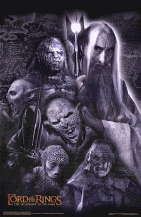 The Lord of the Rings movie has made more than $260 million
since its release on December 19; and in spite of its PG-13 rating and its
occultic imagery, it and its literary counterpart are being praised by
some professing Christians. The Lord of the Rings is the first in a
proposed fantasy trilogy based on the books by J.R.R. Tolkien. The movie
edition of the trilogy was filmed at a cost of $300 million, but as we
have seen, that amount was almost fully recovered a mere two months after
the release of the first episode; and the second and third parts of the
trilogy are yet to appear. The television rights to the trilogy were
recently purchased by WB network for $160 million.
The Lord of the Rings movie has made more than $260 million
since its release on December 19; and in spite of its PG-13 rating and its
occultic imagery, it and its literary counterpart are being praised by
some professing Christians. The Lord of the Rings is the first in a
proposed fantasy trilogy based on the books by J.R.R. Tolkien. The movie
edition of the trilogy was filmed at a cost of $300 million, but as we
have seen, that amount was almost fully recovered a mere two months after
the release of the first episode; and the second and third parts of the
trilogy are yet to appear. The television rights to the trilogy were
recently purchased by WB network for $160 million. 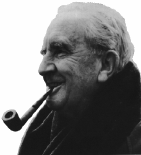 The author of the Lord of the Rings, John
Ronald Reuel Tolkien, was born in South Africa in 1892, but his family
moved to Britain when he was about 3 years old. When Tolkien was eight
years old, his mother converted to Roman Catholicism, and he remained a
Catholic throughout his life. In his last interview, two years before his
death, he unhesitatingly testified, "Im a devout Roman Catholic." J.R.
Tolkien married his childhood sweetheart, Edith, and they had four
children. He wrote them letters each year as if from Santa Claus, and a
selection of these was published in 1976 as "The Father Christmas
Letters." One of Tolkiens sons became a Catholic priest. Tolkien was an
advisor for the translation of the Roman Catholic Jerusalem Bible.
The author of the Lord of the Rings, John
Ronald Reuel Tolkien, was born in South Africa in 1892, but his family
moved to Britain when he was about 3 years old. When Tolkien was eight
years old, his mother converted to Roman Catholicism, and he remained a
Catholic throughout his life. In his last interview, two years before his
death, he unhesitatingly testified, "Im a devout Roman Catholic." J.R.
Tolkien married his childhood sweetheart, Edith, and they had four
children. He wrote them letters each year as if from Santa Claus, and a
selection of these was published in 1976 as "The Father Christmas
Letters." One of Tolkiens sons became a Catholic priest. Tolkien was an
advisor for the translation of the Roman Catholic Jerusalem Bible.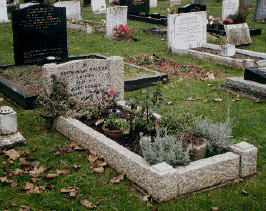
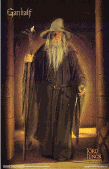 Though the aforementioned reviewers would have us
believe that Tolkiens books contain simple allegories of good vs. evil,
Tolkien portrays wizards and witches and wizardry as both good and evil.
There is white magic and black magic in Tolkiens fantasies. For example,
a wizard named Gandalf is portrayed as a good person who convinces Bilbo
Baggins in The Hobbit to take a journey to recover stolen treasure.
The books depict the calling up of the dead to assist the living, which is
plainly condemned in the Scriptures. Though not as overtly and
sympathetically occultic as the Harry Potter series, Tolkiens
fantasies are unscriptural and present a very dangerous message.
Though the aforementioned reviewers would have us
believe that Tolkiens books contain simple allegories of good vs. evil,
Tolkien portrays wizards and witches and wizardry as both good and evil.
There is white magic and black magic in Tolkiens fantasies. For example,
a wizard named Gandalf is portrayed as a good person who convinces Bilbo
Baggins in The Hobbit to take a journey to recover stolen treasure.
The books depict the calling up of the dead to assist the living, which is
plainly condemned in the Scriptures. Though not as overtly and
sympathetically occultic as the Harry Potter series, Tolkiens
fantasies are unscriptural and present a very dangerous message.