|

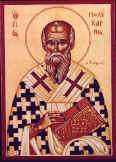
The Life and Martyrdom of Polycarp
(Born about 70 A.D. - Martyred about 168 A.D.)
Pastor David L. Brown, Ph.D. I have an old book in my study that says on its spine "Wake's Epistles." It was printed in 1710. This book contains some of the history and letters of the post-Apostolic preachers and accounts to their suffering and martyrdom. On page 52 there is a chapter on the martyrdom of Polycarp, pastor of the Church of Smyrna. Briefly, let me share with you the story of his life and his death.
Persecution of Christians was the order of the day when Marcus Aurelius was the Emporer of Rome (161-180). For many years Polycarp was spared. But, the full forced of persecution was unleashed on Polycarp in the later years of his ministry. Three days before he was arrested the Lord revealed to him in a dream that he would be burned at the stake. When the soldiers came to get him, his friends insisted on hiding him. Polycarp made it clear that in the future, he would not all himself to be hidden. Soon the soldiers discovered where he had been taken. When he saw them coming, he went out and greeted them warmly and offered them food. As they were eating, he requested that he be allowed to pray before they took him away. His request was granted. For two hours he prayed fervently out loud and my book says, "inasmuch that many of the soldiers began to repent, that they were come out against so godly an old man." When he was done praying they set him on a donkey and took him into the city to be tried as one who was an adversary of the authorized pagan religion. When he arrived, they sat him in a chariot and began to urge him to say the Caesar was God and offer a sacrifice to him. They said, there is no harm in that is there? At first he refused to answer. Finally, after they continued to press him Polycarp said, "I shall not do what you would persuade me to." This made his judges very angry. They had confidently supposed that they would be able to easily persuade him to do what they wanted him to do. They became vicious in their words and actions. They literally threw him out of the chariot he had been sitting in, which cause serious injury to his thigh. This display of force incited the blood thirsty mob to the point that they were so loud in their curses and jeers that no one could hear. As they were dragging Polycarp to the place of execution, a voice rang out from Heaven loud and clear, above the harangue of the crowd which said, "Be strong, Polycarp, and quit thyself like a man." [The phrase "quit you" means, to carry through, or perform to the end. Hence, be strong and stand like a man to the end.] The record states that while no one saw who it was that spoke to Polycarp, many of the believers who were in the crowd clearly heard the voice also. To be sure, Polycarp stood for the Lord Jesus Christ to the end, despite all the efforts to persuade him to renounce Christ. One of the judges tried to get him to deny his faith by saying, "Reverence thy old age…Swear by Casear's Fortune. Repent, and say; Take away the Wicked." The historian goes on to say, "Polycarp, looking with a stern countenance upon the whole multitude of wicked Gentiles, that was gathered together in the Lifts, and shaking his hand at them, looked up to Heaven, and groaning said, Take away the Wicked." But the judge was not satisfied with this. He said, "Sware, and I will set thee at liberty; reproach Christ." It is at this point that Polycarp gives his famous response -- "Eighty and six years have I now served Christ, and he has never done me the least wrong: How then can I blaspheme my King and my Savior?" The judge then angrily urges him to, "swear by the Genius of Caesar." Polycarp refuses, but offered to share his faith in Christ. The judge rejected the offer and threatened, "I have wild beasts ready, to those I will cast thee except thou repent." Polycarp responds calmly, "Call for them then: For we Christians are fixed in our minds not to change from good to evil; But for me it will be good to be changed from Evil, to Good." The furious judge said, "Seeing that thou dispiseth the Wild Beasts, I will cause thee to be devoured by Fire, unless thou shall repent." Polycarp answered, "Thou threatenest me with Fire which burns for an hour, and so is extinguished; but knowest not the Fire of the Future Judgment, and of that Eternal Punishment, which is reserved for the Ungodly. But why tarriest thou? Bring forth what thou wilt!" The judge loudly cried out three times, "Polycarp has confessed himself to be a Christian." The mob responded in fury, "This is the Doctor of Asia; The Father of the Christians; an the overthrower of our Gods. He that has taught so many not to sacrifice, nor pay any worship to the Gods." At first they cried out that the lions should be loosed on him and then that he should be burned alive. They took Polycarp to the stake and were going to nail him there. He spoke up and said, "Let me alone as I am: For he who has given me strength to endure the Fire, will also enable me, without your securing me by nails, to stand without moving in the pile." The merely tied him to the stake. He prayed this prayer before the fire was was kindled -- Lord God Almighty, the Father of thy Well-beloved, and Blessed Son, Jesus Christ, by whom we have received Knowledge of thee; the God of Angels and Powers, and of every Creature, and especially the whole Race of Just Men who live in thy presence! I give thee hearty thanks that thou hast vouchsafed (allowed) to bring me to this Day, and to this Hour; that I should have a part in the Number of thy Martyrs, in the Cup of thy Christ, to the Resurrection of Eternal Life, both of Soul and Body, in the Incorruption of the Holy Ghost. Among which may I be accepted this Day before thee, as a fat and acceptable Sacrifice; as thou the true God, with who is no falsehood, has both before ordained, and manifested unto me, and also hath now fulfilled it. For this, and for all things else, I praise thee, I bless thee, I glorify thee by the Eternal, and Heavenly High Priest, Jesus Christ they Beloved Son; whit whom to Thee and the Holy Ghost, be Glory both now, and to all succeeding Ages, AMEN. Upon the "AMEN" the executioner lighted the fire, but something strange happened. The flames arched around Polycarp like a sail of a ship filled with wind and he would not burn. After some time, the command was given to the executioner to stab him with a sword, so he did. The result was that so much blood flowed from the wound that it extinguished the fire. The fire was rekindled and Polycarps body was burned to ashes. Polycarp was faithful to the Lord unto death. And it is interesting to note that the congregation of the Church of Smyrna believed that the Apostle John, under the inspiration of the Holy Spirit, penned Revelation 2:8-10 with their pastor, Polycarp, prophetically in mind. Revelation 2:8-10 says, And unto the angel of the church in Smyrna write; These things saith the first and the last, which was dead, and is alive; 9 I know thy works, and tribulation…, and poverty, (but thou art rich) and I know the blasphemy of them which say they are Jews, and are not, but are the synagogue of Satan. 10 Fear none of those things which thou shalt suffer: behold, the devil shall cast some of you into prison, that ye may be tried; and ye shall have tribulation ten days: be thou faithful unto death, and I will give thee a crown of life. John wrote Revelation in about 96 A.D. and Polycarp was martyred in about 168 A.D. [Note: The Graphic of Polycarp is from Holy Transfiguration Monastery]
|