|

Biographies of the Herods’
Introduction In this Brief Biography of the Herods’ it will help you understand a bit better numerous events in the New Testament and which Herod it was that was involved. Herod Antipater I the Idumaean (73 to 43 B.C.) is the founder of the Herodian Dynasty and the father of Herod the Great. He is not mentioned in the New Testament, but his ten of his descendants played major roles in the lives of Jesus and of the apostles. The Herod family were Idumeans. That is, they were descended from Abraham through Isaac and Esau, rather than through Isaac and Jacob. They saw themselves as Jewish, participating in God’s covenant with Abraham, but their ancestors had not gone to Egypt with Joseph and returned with Moses and Joshua. Herod Antipater formally converted to the Jewish religious practice of the descendants of Jacob. His family would not allow their portraits (graven images) on the coins they issued, they did not eat pork as they followed the Jewish dietary laws, and the women of the family were not allowed to marry men who were uncircumcised. However, they were not separate in other areas as the Jews were. Their children often received a secular education. Members of the family sponsored athletic games in the Greek style, which were offensive to the Jews. And they also arranged marriages between uncles and nieces in the Roman fashion and their children. Herod Antipater was the father of… 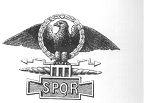 Herod The Great
(73-4 B.C.) This Herod undertook great building projects in Palestine, including
whole cities like Caesarea Maritima and Masada and the rebuilding of Jericho.
Most important, he rebuilt the Temple of Solomon in Jerusalem. He was given the
title “King of the Jews.” After he completed the work, he deeply offended the
Jews of Jerusalem by placing an eagle, the emblem of Roman rule, on the Temple.
His last act in life was overseeing the execution of the Jews who tore it down.
He is the Herod who ordered the Bethlehem children two years old and under to be
killed (Matthew 2:16). Herod The Great
(73-4 B.C.) This Herod undertook great building projects in Palestine, including
whole cities like Caesarea Maritima and Masada and the rebuilding of Jericho.
Most important, he rebuilt the Temple of Solomon in Jerusalem. He was given the
title “King of the Jews.” After he completed the work, he deeply offended the
Jews of Jerusalem by placing an eagle, the emblem of Roman rule, on the Temple.
His last act in life was overseeing the execution of the Jews who tore it down.
He is the Herod who ordered the Bethlehem children two years old and under to be
killed (Matthew 2:16). At the death of Herod the Great, the Jews begged Augustus not to appoint another ruler over them like Herod. After much deliberation, Augustus Caesar decided to split the Jewish kingdom into three parts, and appoint a different ruler over each section. These officials would have far less power than Herod had, and most of the control would come from Rome. These three rulers, all of whom were sons of Herod the Great, were: Herod Archelaus -- who was given the area of Samaria, Judea, and northern Idumaea. Herod Antipas -- who was given Galilee and Peraea. Herod Philip -- who was given the area east and northeast of Jordan from the Yarmuk River to Mount Hermon. We will look at each of these men. Herod Archelaus (23 to 18 A.D.) was full brother of Herod Antipas and a half brother of Herod Philip. When they were young, he along with these brothers, he was sent as a hostage to Rome, where they received their education. It insured their father’s allegiance to Rome. In his father's testament, Herod Archelaus was appointed king, but the Roman emperor Augustus wrote him that he had to be satisfied with the title of ethnarch (‘national leader’) of Samaria, Judaea and Idumea. Immediately after his accession to leadership in 4 B.C., things went wrong. When Herod had fallen ill, two popular teachers, Judas and Matthias, had incited their pupils to remove the golden eagle from the entrance of the Temple. After all, according to the Ten Commandments, it was a sin to make idols. The teachers and their pupils were burned alive. The new king had to face an angry crowd at these men being martyred. Things went from bad to worse. Archelaus was the most wicked of the three brothers. We read of him in Matthew 2:22-23 “But when he [Joseph] heard that Archelaus did reign in Judaea in the room of his father Herod [the Great who kille the children of Bethlehem], he was afraid to go thither: notwithstanding, being warned of God in a dream, he turned aside into the parts of Galilee: 23 And he came and dwelt in a city called Nazareth: that it might be fulfilled which was spoken by the prophets, He shall be called a Nazarene.” Archelaus married Glaphyra, the wife of his half-brother, divorcing his own wife in order to do so. This outraged the Jews, and when a rebellion broke out in Jerusalem during the Passover season, his troops killed over 3000 Jews. His was a reign of terror. In the ninth year of his reign (he reigned from 4 B.C. to 6 A.D.), a delegation of leading men from Judea and Samaria went to Rome to appeal to Augustus to have him removed. Augustus agreed to their demands and removed Herod Archelaus. He also confiscated his fortune and banished him to Gaul. This section of Palestine was then placed under a military governor (a Roman Procurator who was directly responsible to the Emperor). There would be fourteen of these procurators up to the fall of Jerusalem in 70 AD, three of whom are of special interest to the study of the New Testament times: 1. Pontius Pilate (26 - 36 A.D.) who is mentioned 56 time in the New Testament; 9 times in Matthew, 10 times in Mark, 12 times in Luke; 21 times in John; 3 times in Acts; 1 time in 1 Timothy 2. Antonius Felix (52 - 60 AD) who is mentioned 9 times in Acts 23-24 and, 3. Porcius Festus (60 - 62 AD) who is mentioned 13 times in Acts 24-26. Herod Antipas (20 B.C. to after 39 A.D.) was Tetrarch (ruler of a quarter) of Samaria, Galilee, Peraes and Idumea between 4 B.C and 39 A.D. He is called that in Matthew 14:1; Luke 3:1,19; 9:7 and Acts 1:3. Often he is called simply Herod. In 17 A.D., he founded a new capital, which he called Tiberias, to honor the Roman emperor, Tiberius. Unfortunately, it was discovered that he was building this city on top of an old Jewish graveyard. This caused great unrest among his Jewish subjects. For a long time, no pious Jew would enter Tiberias, which was populated by primarily Greeks and Romans. Their cousin, Herodias, first married and divorced an uncle living in Rome, then married Philip, and then divorced Philip to marry Antipas. When John the Baptist preached against Antipas marriage to the former wife of his half brother Philip. For this Antipas had him thrown into prison. The daughter of Herodias by her first marriage is unnamed in the New Testament, but she is called Salome (a common name in the family) in later accounts. With her mother's prompting, she requested the head of John the Baptist on a platter, and Antipas ordered John beheaded (Mark 6:14-29; Matthew 14:1-12). In Mark 8:15, when Jesus warned the disciples against the leaven of the Pharisees and of Herod, he was talking about Herod Antipas. Antipas was also the fox that the Pharisees warned Jesus about in Luke 13:31-32. Antipas presided over Jesus’ trial in Luke 23, and with Pontius Pilate, the Roman procurator, determined Jesus' death sentence. John and Peter refer to the decision of Antipas and Pontius Pilate to execute Jesus in Acts 4: 27. Herod Philip (27 B.C. to 34 A.D.) was the Jewish leader, ruled between 4 B.C. and 34 A.D. in the southwest of what is now Syria. He was the first wife of Herodias (Mark 6:17). Apart from that passing reference there is not other mention of him in the New Testament. Moving on from the three brothers, Archelaus, Antipas and Philip, the next Herod we come to is…. Herod Agrippa I (10 B.C. to 44 A.D.) (also called Herod the Great, which can be very confusing) was the grandson of Herod the Great. He had another son, Aristobulus. He executed him in 7 B.C. fearing he would take his throne. The Roman Emperor Autustus joked that is was better to be Herod’s pig (hus) than his son (huios), a very insulting remark for any Jew. Aristobulus has a son, Agrippa, named after Augustus’ friend Marcus Vipsanius Agrippa. His son was spared. Herod Agrippa I ruled from 37 to 44 A.D. Because of his friendship with the Emperor Caligula, he is the first Herod to be called King since his grandfather Herod the Great. In January 41 A.D., Caligula, who was by now showing signs of complete insanity, and Herod Agrippa were in Rome. On the 24th, the emperor was murdered, and the Jewish king played a very important role during the accession of Claudius. The latter was grateful to Agrippa; Judaea and Samaria were added to Herod Agrippa's realm. He was now king of all the territories that had once been ruled by Herod the Great. Jerusalem was again the capital of Palestine as a whole and received new city walls. Agrippa's entry in the city of David and Herod was a triumph. After these successes, a strange incident took place in 44 A.D. Lets read Acts 12:1-3 and 19-23. He is at Caesarea Maritima and he dies of being eaten of worms. After some troubles the last king of the Jews was succeeded in some of his territories by his son Julius Marcus Agrippa or Agrippa II. Agrippa's daughter Drusilla was married to Marcus Antonius Felix, the procurator of Judaea (52-58); Agrippa's daughter Berenice was the mistress of the future emperor Titus. Julius Marcus Agrippa or Agrippa II (27/28 to about 100 A.D.) ruled 48-100 A.D. He was the last important descendant of king Herod the Great. He is a very important figure in the life of the Apostle Paul in Acts 25:18-22 and Acts 26. In conclusion, hope this study will help you to better understand the Herods’ you come across in the New Testament. |